What Is the Rule of 3 in Landscaping? A Buffalo Homeowner’s Complete Guide
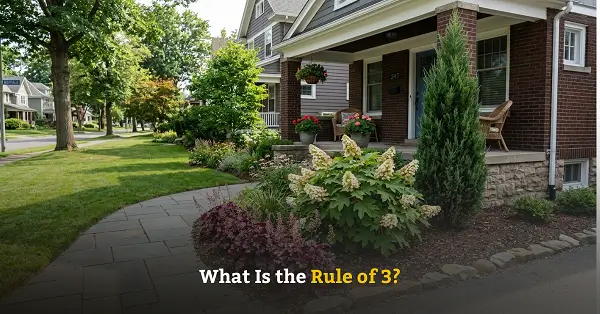
You spent real money on plants. You put in the hours. And when you stepped back to look at the finished yard, something was still off. Not bad, exactly. Just not right.
That feeling has a name. And more importantly, it has a fix.
In over a decade of working on yards across Buffalo, from tight city lots on the West Side to sprawling backyards in East Amherst and Orchard Park, we’ve traced that “something’s off” feeling back to the same root cause almost every time. The rule of 3 was being ignored. Not on purpose. Most homeowners just don’t know it exists.
By the time you finish reading this, you will.
What Is the Rule of 3 in Landscaping?
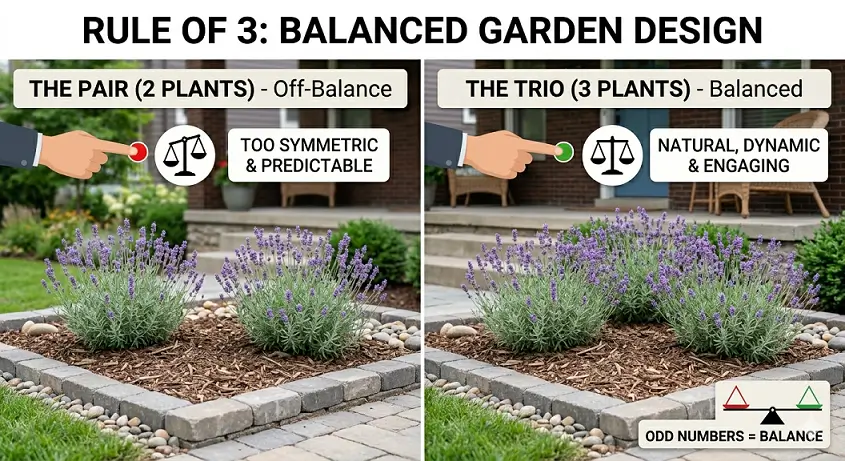
The rule of 3 in landscaping is a design principle that says plants, hardscape elements, and outdoor features look most visually balanced when arranged in groups of three or in odd numbers generally. One plant looks lonely. Two plants make your eye bounce back and forth with no resolution. Three plants create a composition. Your eye moves across them and settles naturally.
It sounds almost too simple. But the results are not simple at all.
This principle doesn’t just apply to plants. It governs everything in a well-designed yard like stone groupings, lighting fixtures, color palettes, height layers, even the way a patio relates to the lawn and the garden bed. The rule of 3 is the underlying logic that separates a yard that looks designed from one that looks assembled.
Why the Rule of 3 Works | The Psychology Behind It
Your brain processes symmetry as safe and asymmetry as interesting. Two of anything is perfectly symmetrical. It reads as formal, rigid, and resolved. There’s nowhere for the eye to go.
Three breaks that symmetry just enough. The odd number creates what designers call visual tension — not the bad kind, but the kind that makes you keep looking.
Your eye moves from one element to the next, finds no exact mirror, and keeps traveling across the space. That movement is what makes a yard feel alive rather than staged.
This isn’t a landscaping invention. Painters have used it for centuries. Interior designers swear by it. Film directors use it in every frame they compose.
Landscape designers borrowed it because it works on the human brain regardless of what it’s looking at.
In Buffalo neighborhoods, you’ve probably felt this without knowing why. Drive down Delaware Avenue or through Williamsville on a weekend. The yards that make you slow down don’t have one perfect specimen tree dropped in the center of a lawn.
They have groupings, things arranged so your eye is guided from one spot to the next, then to the next, and the whole yard feels like one thought instead of several accidents.
How the Rule of 3 Is Applied in Landscaping
Understanding the rule is one thing. Knowing where it actually shows up in your yard is another. Here’s how professional landscapers use it across every element of an outdoor space.
1. Plant Groupings | The Foundation of the Rule
This is where most homeowners first encounter the rule, and where ignoring it does the most visible damage.
Instead of planting one shrub, plant three. Instead of a single ornamental grass at the corner of your bed, use three — varied slightly in placement so they don’t form a rigid line. The grouping reads as intentional. The single plant reads as an afterthought.
When you select those three plants, they shouldn’t be identical. That’s just repetition, not composition. The goal is three plants that relate to each other — similar enough to feel like a family, different enough to each contribute something distinct.
In Buffalo’s Zone 6a climate, a strong three-plant grouping might look like this:
- A Black-Eyed Susan for height and upright structure.
- A Blue Salvia for mid-level volume and cool color contrast
- A Creeping Phlox as a low ground-hugging anchor.
Three heights. Three textures. One cohesive group. And all three are proven survivors of a Western New York winter.
Once you build one grouping that works, you repeat it or a variation of it across the yard. That repetition creates rhythm.
Rhythm is what makes a large yard feel designed from corner to corner rather than in patches.
2. Height Variation: Tall, Medium, Low
Every grouping of three should include:
- A tall element
- A mid-height element
- A low to the ground.
This is called layering, and it is the single most visible difference between amateur planting and professional results.
When everything sits at the same height, the bed looks flat. It reads like a row, not a design. The moment you introduce three distinct height levels, the bed gets depth.
It looks full even when it’s not crowded. It draws the eye in instead of just across.
For Buffalo front yards, which tend to be narrower than backyard spaces. Layering becomes even more critical.
You don’t have width to work with, so you build upward.
- A tall ornamental grass or upright shrub in the back
- A rounded mid-height perennial in the middle
- A low creeping plant at the border.
That’s three levels. That’s a front bed that looks finished.
3. Color and Texture Balance
Professional designers limit themselves to three colors per planting zone.
Not two, which feels thin. Not four or five, which creates chaos.
They go with three colors combination:
- One dominant color
- One secondary
- One accent
The same logic applies to texture. Landscape designers think in three texture categories:
- fine (thin blades, delicate leaves)
- Medium (standard leaf size, average density)
- Bold (large leaves, heavy structure).
One of each in a grouping gives you contrast without conflict.
In Buffalo, this matters more than in warmer climates because your color window is short. You have roughly May through September, where color is doing real work in your yard.
Getting the color groupings right means making every week of that window count. A yard with a clear three-color structure looks deliberate in June and still holds together in August when some plants have finished blooming.
For homes with the red brick or vinyl siding common across South Buffalo and the inner suburb following colors tend to photograph beautifully and hold visual interest through the season without fighting the architecture.
- Cool blues
- Purples
- And Whites
4. Hardscape Elements | It’s Not Just About Plants
This is where most landscaping guides stop short. They treat the rule of 3 as a planting principle and nothing more. It’s not.
Every hardscape decision in your yard benefits from the same logic. Three decorative boulders placed as a ground-level accent read as designed. Two boulders look like they were left there. One looks like a mistake.
Three lighting fixtures along a path edge, positioned at varying intervals rather than equally spaced, create movement.
Three tiers on a retaining wall give it architectural weight.
This matters enormously for Buffalo homeowners, because hardscape is what carries your yard visually through October, November, and beyond.
A well-designed patio with three distinct anchor points, or a boulder grouping that sits at a corner bed, keeps your yard looking intentional year-round. In a city where you’re staring at your yard through a window for five months of winter, that’s not a small thing.
5. Focal Points | Guide the Eye Across the Whole Yard
A well-designed yard has three focal points, not one.
- An entry focal point draws you in from the street.
- A mid-yard focal point holds your attention once you’re in the space.
- A destination focal point, at the back of a garden, at the edge of a patio, at the far corner of a lawn gives the eye somewhere to land.
Without three points working together, a yard has no journey. You look at it from one spot and you’ve seen it. With three deliberate focal points, the yard reveals itself gradually.
That’s the difference between a yard that photographs well from one angle and a yard that actually feels good to spend time in.
6. Pathways, Edging, and Borders
A clean border between your lawn and your beds is one of the fastest visual upgrades a Buffalo yard can get and the rule of 3 applies here too.
If you’re using edging materials, three different materials or three distinct border plant varieties along a long bed line create rhythm without boredom.
Sharp edging placed in a three-curve layout along a straight stretch softens the geometry of the bed and makes the whole planting feel more natural.
This is a detail that most homeowners overlook but every landscaper notices immediately when walking a property.
7. Seasonal Appeal | Especially Critical in Buffalo
This is where Buffalo landscaping has to think differently than the rest of the country.
A landscaper in Georgia can get away with designing for one season and calling it done. In Western New York, you get roughly five months of real growing season, May through September, and seasonal cleanup between those months is what keeps these groupings looking sharp from one year to the next.
If you don’t design your plant groupings to cover all three seasons within that window, your yard peaks in June and looks exhausted by August.
The rule of 3 solves this when you apply it seasonally. Build each grouping of three plants so one blooms in spring, one carries the summer, and one delivers fall color or structure.
- A Forsythia brings early-spring yellow before most things wake up.
- A Coneflower takes over through July and August.
- An ornamental grass or Sedum holds structure and color into October.
Add an evergreen as the anchor plant in at least every other grouping like:
- A Boxwood
- A Dwarf Spruce
- An Inkberry Holly
You have something green and structured visible from your window in January.
In Buffalo, that matters more than people realize until they’re staring at a completely brown and flat yard for the fourth month in a row.
8. Landscape Lighting | The Rule of 3 After Dark
A well-lit yard uses three types of lighting working together:
- Uplighting to highlight architectural plants or trees.
- Path lighting to guide movement through the space.
- Accent lighting to add depth and drama at ground level.
Any one of these alone looks incomplete. Two feels like you started and stopped.
Three types, balanced across the yard, makes the space feel finished and, in Buffalo, extends the hours you can actually enjoy your outdoor space.
In July and August, when daylight runs until 9pm, good lighting means your backyard is usable well into the evening.
Place fixtures in groupings of three or five rather than evenly spaced rows. Odd-numbered placement looks natural. Even spacing looks like a parking lot.
9. Water Features and Decorative Elements
Birdbaths, urns, ornamental grasses used as accent pieces, decorative stones. All of them follow the same rule.
Group them in threes. A single decorative urn on a patio looks placed there temporarily. Three urns at varying heights, planted with complementary trailing plants, become a design moment.
For smaller Buffalo lots where a full water feature isn’t practical, a small fountain grouped with two flanking ornamental grasses creates the same visual weight as a much larger feature.
Scale your elements to your lot size, but keep the grouping logic intact.
Common Mistakes Buffalo Homeowners Make When Ignoring the Rule of 3
These mistakes come up constantly. If your yard currently looks “off” and you can’t place why, one of these is likely the reason.
Planting A Single Specimen Shrub With Nothing Around It
It looks like it was forgotten there. Even the most beautiful shrub reads as isolated rather than designed when nothing supports it.
Symmetrical Pairs Flanking A Walkway
Two matching plants on either side of a front path is the most common planting mistake in Buffalo residential yards.
It looks formal, rigid, and dated. It works for federal buildings. It doesn’t work for a 1950s Cape Cod in Cheektowaga.
Mixing Too Many Colors Without An Anchor
Five colors in a 10-foot bed creates visual noise. Three colors, properly distributed, creates a palette.
Know the difference before you go to the nursery.
All Plants At The Same Height
No layering means no depth. The bed looks flat no matter what you put in it.
Buying Plants In Even Numbers Because It “Feels Balanced.”
It doesn’t look balanced — it looks like pairs. Buy three, or five, or seven.
Never two or four if the goal is a natural, designed appearance.
Ignoring Hardscape In The Rule
You can have perfect plant groupings and still have a yard that looks unfinished because the patio, boulders, or edging work against the design instead of with it.
Not Accounting For Mature Size In Buffalo’s Growing Conditions
Three plants that look right at purchase can become an overcrowded mess in two growing seasons. Know the mature spread of what you’re planting and space accordingly.
Buffalo’s clay-heavy soil holds moisture well, which means plants establish faster here than in drier climates.
What to Realistically Expect When Applying the Rule of 3
Most homeowners can apply the rule of 3 to a single bed on their own, but when it covers the whole yard, professional Buffalo landscaping services make the difference between a yard that almost works and one that clearly does.
Applying the rule of 3 to a single garden bed is genuinely something a motivated Buffalo homeowner can tackle on their own.
Pick three plant varieties, think through height and color, place them in a loose triangle rather than a straight line, and repeat the grouping down the bed. The results are usually noticeable immediately.
It gets complicated is when the whole yard needs to work together.
- Front yard
- Backyard
- Side beds
- Hardscape
- Lighting
Getting all of those groupings to talk to each other across the entire property is a different skill set.
The eye has to travel correctly from the street to the front door, from the patio to the garden, from the main lawn to the border plantings. That’s not something a plant list fixes. That requires someone who can walk the property and see the whole picture.
Most homeowners we work with in Buffalo don’t need a complete redesign. They need a professional to identify the three or four specific changes that will make everything they’ve already done start making sense.
Sometimes that’s a plant swap. Sometimes it’s a hardscape anchor. Sometimes it’s just moving something that’s in the wrong place.
The rule of 3 gives the diagnosis. Experience gives the fix.
FAQ
Ready to Bring the Rule of 3 to Your Buffalo Yard?
You don’t need to have everything figured out before you call. Most of the best yard transformations we’ve done in Buffalo started with a homeowner who just knew something wasn’t working and couldn’t name what.
We can name it. And we can fix it.
We work across Buffalo and the surrounding areas — Amherst, Williamsville, Tonawanda, Cheektowaga, Orchard Park, East Aurora, and everywhere in between. We know this climate, this soil, and the specific challenges of making a Western New York yard look great for as many months of the year as possible.
Call us today and let’s talk about your yard.
One conversation. No pressure. Just a clear picture of what your yard could look like.