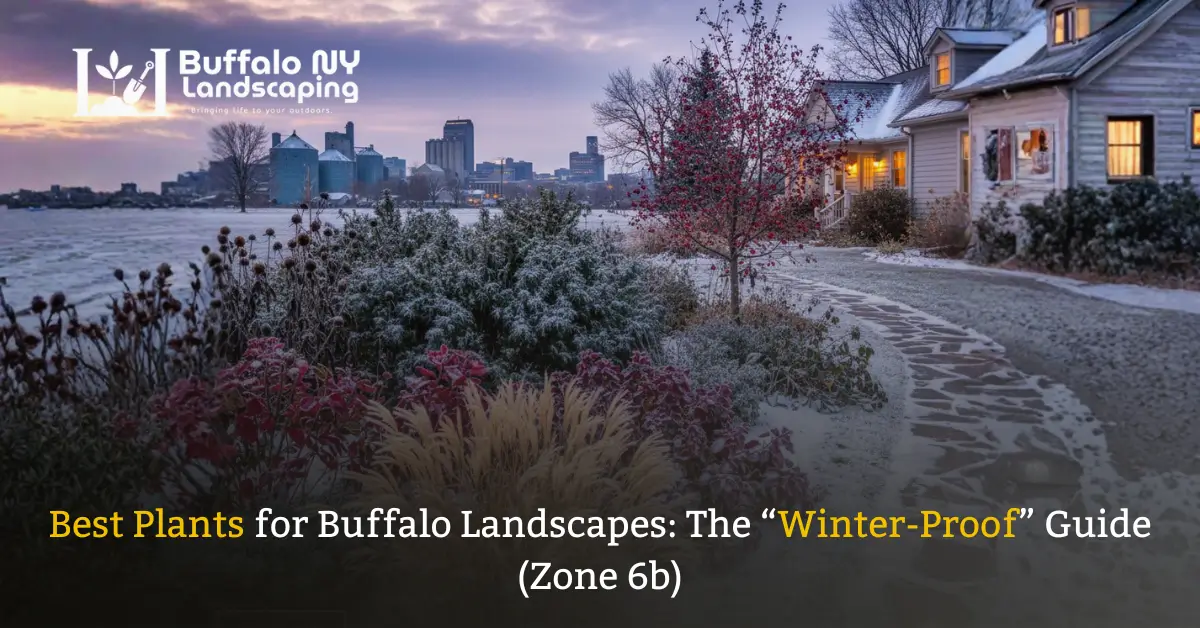
Best Plants for Buffalo Landscapes: The “Winter-Proof” Guide (Zone 6b)
Buffalo gardening is not for the weak.
If you live here, you know the deal. You get buried by Lake Effect snow in Hamburg. You fight heavy, sticky clay soil in Amherst. Then, just when you think spring is here, a late April freeze kills your new blooms.
It is frustrating.
Most generic gardening blogs fail you. They recommend plants that look great in a catalog but snap under two feet of wet “heart attack” snow. Or they suggest shrubs that the suburban deer population treats like a salad bar.
Stop wasting money on plants that die.
This guide is different. We are local. We know the 716 climate. As Buffalo NY landscaping experts, we design and build outdoor spaces specifically for Western New York’s extreme weather, not generic climates.
We didn’t just Google “hardy plants.” Instead, we examined what’s growing in your neighbor’s yard right now. The survivors. Under heavy snow, trees with roots that punch through clay bend, but don’t break.
Sick of fighting Buffalo clay soil and winter damage on your own?
Our professional landscaping services in Buffalo handle everything, from soil prep and planting to long-term landscape design built for Zone 6b conditions.
Call us +1 (716) 349-3625 today for a free landscaping quote and let’s build a yard that lasts.
Understanding Buffalo’s Gardening Challenges (Why Plants Die Here)
Why is gardening in Buffalo so hard?
Buffalo sits in USDA Hardiness Zone 6a/6b. This means plants must survive lows of -10°F. The real killers are heavy clay soil and heavy wet snow, which rot roots. Poor drainage or weight can kill a plant.
The “Lake Effect” Factor & Snow Load
It’s not just the cold. It’s the weight.
Heavy snowfall doesn’t just damage plants. It affects access, safety, and property maintenance, which is why many homeowners also rely on snow removal in Buffalo NY to protect their landscapes and hardscapes during peak winter months.
In the Southtowns, we get hit with heavy, wet snow. It sticks to everything. Brittle trees like Bradford Pears explode under this pressure.
You need plants with flexible structure.
We look for “winter silhouette” trees. These have strong, elastic wood. They bend down to the ground and pop back up when the snow melts. Think of native evergreens or shrubby dogwoods. If the branches are stiff, they are liabilities.
Surviving Heavy Clay Soil
Dig a hole in your backyard. Fill it with water. Come back in an hour.
Is the water still there? That’s Buffalo clay.
Most plants hate “wet feet.” Their roots need air. In dense clay, water sits stagnant. The roots rot. Then the plant starves.
You have two choices.
- Amend the soil: Mix in tons of compost to break up the clay.
- Pick tough plants: Choose species like Black Gum or River Birch that don’t mind heavy soil.
Pairing the right plants with proper winter lawn care tips helps Buffalo homeowners protect their landscapes year after year.
The Deer Problem
Live in Williamsville? Or Orchard Park? Then you have deer.
They are hungry. In February, when the ground is frozen, your expensive Arborvitae looks like a snack.
Physical barriers work best. But “deer-resistant” plants help. Strong-scented herbs and fuzzy-leaved shrubs deter them. We focus on plants they usually skip.
Best Trees for Buffalo: Winter Silhouettes & Form
Everyone buys trees for their leaves. That is a rookie mistake.
In Buffalo, trees are bare for five months. You stare at sticks from November to April.
You need a tree with “Winter Appeal.” You want interesting bark. Cool branching patterns. A stunning form that looks good against a grey sky.
Here are the best trees that survive our winters and look good doing it.
Pagoda Dogwood (Cornus alternifolia)
This is the architect’s favorite.
The branches grow in distinct, horizontal layers. It looks like a tiered pagoda. When snow lands on it, those flat layers hold the white powder beautifully. It creates a striking winter silhouette.
It’s not just a winter tree, though. In autumn, you get deep reddish-purple fall color. It’s a smaller tree, perfect for planting near a patio where you can admire the shape.
Shagbark Hickory (Carya ovata)
Want a tree that your grandkids will climb? This is it.
The Shagbark Hickory is a large tree built for the long haul. Its name tells the story. The bark peels away in long, shaggy vertical strips. It looks rugged.
Against a white snow backdrop, that shaggy bark provides incredible texture. It supports local wildlife, too. It’s a native powerhouse that handles our climate zones easily. According to the U.S. Department of Agriculture, it’s rock-solid in Zone 6.
Red Mulberry (Morus rubra)
This is a rare find. Most mulberries you see are invasive weeds.
The native Red Mulberry (Morus rubra) is different. It’s a tough, mature tree that feeds the neighborhood birds. It produces sweet mulberry fruits (often called Juneberries by locals) in early summer.
It has a gnarly, craggy shape as it ages. It adds character to a yard that generic maples can’t match. Plus, it thrives in spots where other trees struggle.
Serviceberry (Amelanchier canadensis)
Call it Shadblow. Call it Serviceberry. Call it Saskatoons.
Whatever you call it, you need one.
This is a multi-stemmed shrubby tree. It stays small (15-25 feet). It’s a four-season worker.
- Spring: Explosive white flowers before leaves appear.
- Summer: Edible purple berries (tastes like blueberry pie).
- Fall: Fiery orange-red leaves.
- Winter: Smooth gray bark with vertical stripes.
It loves our soil. It loves our cold.
Black Gum (Nyssa sylvatica)
Stop planting Sugar Maples if you want red color. Plant this instead.
The Black Gum (or Tupelo) offers the most intense scarlet fall color in the forest. The leaves look polished and shiny all summer.
But it’s the structure that wins. It has a straight trunk and horizontal limbs, giving it a stunning form. Its roots are aggressive and strong—they anchor deep into our clay. It’s a slow grower, but the eventual payoff is a magnificent, storm-resistant shade tree.
Bulletproof Shrubs for Buffalo (Low Maintenance)
You are busy. You don’t want to spend every Saturday trimming hedges.
We get it.
You need shrubs that show up, look good, and don’t die. We call these the “Bulletproof” list. They handle the snow load and the salt spray without complaining.
Green Mountain Boxwood
Most Boxwoods turn brown in Buffalo winters. The wind burns them.
Not the Green Mountain Boxwood. This variety is bred to stay green. It grows in a natural pyramid shape, so it sheds heavy snow easily. If you want that crisp, formal shape without wrapping your bushes in burlap every November, get this one.
Bonus: It is generally deer-resistant. They will eat it if they are starving, but they prefer your hostas.
Panicle Hydrangeas (The “Hardy” Hydrangea)
Stop buying those blue “Endless Summer” hydrangeas. They die back to the ground every winter and never bloom.
Switch to Panicle Hydrangeas (Hydrangea paniculata). Varieties like ‘Limelight’ or ‘Bobo’ are indestructible. They bloom on “new wood” (the current year’s growth). That means even if the winter freezes the stems, they will still flower in August.
Leave the dried flower heads on for winter. They catch the snow and add nice texture.
Witch Hazel (Hamamelis)
This shrub plays by its own rules.
Witch Hazel blooms in February. Yes, February. While your yard is covered in snow, this plant pushes out spindly yellow or orange flowers. It smells amazing.
It has a wide, vase-like interesting form. It’s a great background shrub that offers a surprise pop of color when you are sick of the grey winter.
Rugosa Rose
Do you live on a busy street? Do the plow trucks blast your front yard with salty slush?
Most plants die from that salt. The Rugosa Rose drinks it up. It is naturally salt tolerant.
It’s tough, thorny, and covers itself in pink or white flowers all summer. In the fall, it produces giant orange “rose hips” (fruit) that look like ornaments. It’s practically unkillable.
Native Perennials: The “Set and Forget” Garden
Native plants are lazy. That is a good thing.
They evolved here. They know how to handle a 716 drought and a 716 freeze. Once their roots are established, you rarely have to water them.
Purple Coneflower & Black-Eyed Susan
These are the classics for a reason. Purple Coneflower (Echinacea) and Black-Eyed Susan (Rudbeckia) are staples for U.S. users.
They have massive, deep root systems that break up clay soil. They bloom for months. Leave the seed heads up in the fall—Goldfinches love to eat the seeds during winter.
Joe-Pye Weed
Need to hide an ugly fence? Use this.
Joe-Pye Weed is a monster. It grows 5 to 7 feet tall in one season. It is tall and architectural. In late summer, it gets topped with massive pink flower clusters that smell like vanilla.
It is a total butterfly magnet. If you plant this, Monarchs will find you.
Switchgrass (Panicum virgatum)
Don’t forget the grass. Not the kind you mow—the kind you watch.
Switchgrass is a tall, native ornamental grass. It stands up straight, even in winter. When the wind blows off Lake Erie, this grass sways and rustles. It adds winter movement and texture to a flat, snowy yard.
In the fall, it turns a golden-yellow. It’s the perfect “filler” plant to put between your flowers.
Designing for “Curb Appeal” in the 716
Selling your house in Elmwood Village? Or just want to make the neighbors jealous?
A few random bushes won’t cut it. You need a design strategy.
Great curb appeal isn’t about having the most plants. It’s about having the right plants in the right order. Here is the secret formula landscapers use.
Creating Layers (The “Staircase” Effect)
Think of your garden bed like a class photo. Tall kids in the back, short kids in the front.
If you plant a tall shrub in the front, you hide everything behind it. You need the “Staircase” Effect:
- Back Row: Tall evergreens or grasses (Switchgrass, Arborvitae) to frame the house.
- Middle Row: Flowering shrubs (Hydrangeas, Boxwood) to add mass and color.
- Front Row: Low perennials (Coneflowers, creeping sedum) to soften the edge.
This creates depth. It makes a small yard look huge.
Mixing “Winter Interest” with Summer Blooms
In Buffalo, your yard is leafless for half the year. If you only plant for July flowers, your house looks dead from November to April.
You must mix in Winter Interest.
Balance the summer bloomers with “winter structure” plants.
- Plant a Red Twig Dogwood for bright red stems against the snow.
- Add a Serviceberry for its smooth gray bark and winter silhouette.
- Include a Holly bush for red berries.
When the flowers die, the bark and berries take over. Your curb appeal never sleeps.
Why You Should Skip the Big Box Store?
You see a cheap Hydrangea at the hardware store. It looks healthy. You buy it.
It dies in October. Why?
Big box stores ship plants in from warmer states. That shrub might have been grown in a greenhouse in Tennessee. It has no idea what a Buffalo winter is. It isn’t hardened off.
Local nurseries are different.
They stock plants grown in the north. Their root balls are bigger. The stock is acclaimed to our Zone 6b climate. You pay a little more upfront, but you buy it once. Generic stock is a gamble you usually lose.
Planting & Maintenance: The Reality Check
We listed the plants. Now let’s talk about the work.
Gardening in WNY is physically demanding. Before you grab a shovel, you need to know what you are up against.
The Truth About Digging in Buffalo Clay
If you live north of the city (Amherst, Tonawanda), you don’t have soil. You have concrete that gets wet.
Digging a hole for a 15-gallon tree in pure clay is brutal. It is heavy, sticky, and it breaks shovels. You can’t just drop a plant in. You have to over-dig the hole and mix in bags of peat moss and compost. If you skip this, you are basically planting your tree in a clay pot. It will drown.
It’s back-breaking labor. Literally.
Mulching & Winter Protection
Mulch isn’t just for looks. In Buffalo, it’s insulation.
Our biggest enemy is the “Freeze/Thaw Cycle.” The ground freezes, then thaws, then freezes again. This pushes plants right out of the ground (called “frost heave”).
You need a solid 3-inch layer of hardwood mulch. It acts like a blanket. It keeps the soil temperature stable so your expensive new perennials stay safely underground.
When to Prune for Winter Form
You can’t just hack away at trees whenever you want.
If you want that perfect winter structure, you need to prune at the right time. For most trees, that is the dormant season (late winter, before buds break).
Proper pruning isn’t about shortening branches. It’s about thinning them. You remove the “crossing branches” that rub against each other. You open up the center of the tree to let light in. This reveals the natural architecture of the plant.
It’s an art form. One bad cut can ruin the shape forever.
Why Choose Buffalo NY Landscaping for Your Installation?
You could spend your weekends fighting the clay. Or you could let us handle it.
We aren’t a national chain. We are locals. We know which side of the street gets the wind tunnel effect in Cheektowaga. We know which plants the deer ignore in Orchard Park.
We Know What Survives Here
We don’t plant “hope.” We plant certainty.
We have seen what the Blizzard of ’22 did to weak trees. We know what survives a polar vortex. When we recommend a plant, it’s because we have seen it thrive here for years. We bring local expertise that a Google search can’t give you.
Warranty & Soil Prep
Most DIY plantings fail because of the soil.
When we install a landscape, we don’t just dig a hole. We fix the ground. We amend that heavy clay with rich organic matter to ensure drainage. We are so confident in our prep work that we offer a warranty on our plantings. If we plant it, we stand behind it.
Design for Year-Round Appeal
Your yard shouldn’t look like a dead zone in January.
We design for all four seasons. We strategically place evergreens, red-twig dogwoods, and ornamental grasses so your home has curb appeal even when it’s 10 degrees out. We build landscapes that look good in June blooms and February snow.
Ready to transform your yard?
Stop guessing. Start growing.
Click Here to Call Us +1 (716) 349-3625 for a Free Consultation